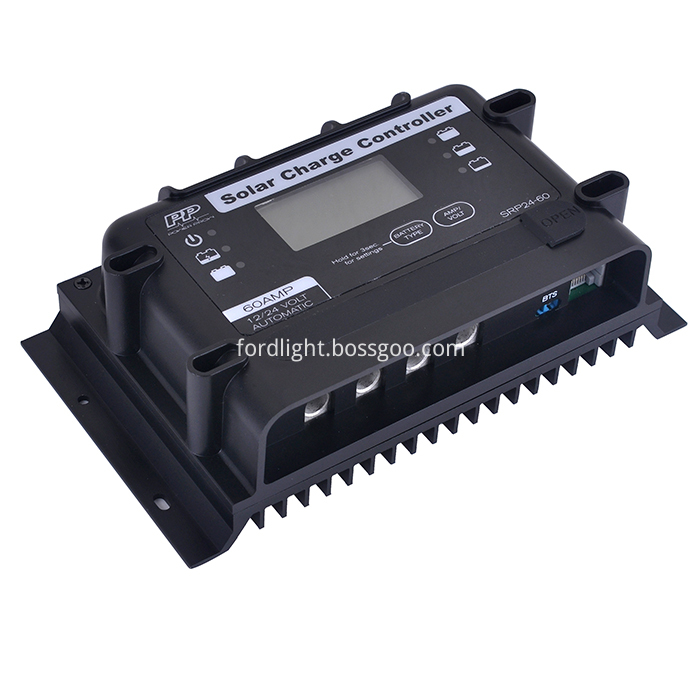
1. REDUCING THE VOLTAGE OF YOUR SOLAR PANEL
.Without a Solar Charger between a solar panel and a battery, the panel would overcharge the battery by generating too much voltage for the battery to process, seriously damaging the battery.
.Overcharging a battery could result in the battery exploding!
2. MONITORING THE VOLTAGE OF YOUR BATTERY
.The Solar Charger detects when the battery`s voltage is too low. When the battery drops below a certain level of voltage, the Solar Charger disconnects the load from the battery in order to prevent the battery from being drained.
.A completely drained battery will lose some of its overall capacity.
.Low voltage can still damage the battery if the load is connected.
3. STOPPING REVERSE CURRENT AT NIGHT
.The Solar Charger stops any current from flowing back into the solar panel at night.
.This prevents any damage to your solar charging kit.
NOTE: The Solar Charger can also regulate current from the load when the load is connected to Solar Charger. The load terminal on the Solar Charger is for direct connection of the load to the Solar Charger - unlike a wind turbine controller, it is NOT a load dump. The Solar Charger can still operate as normal if there is no load directly connected to it.
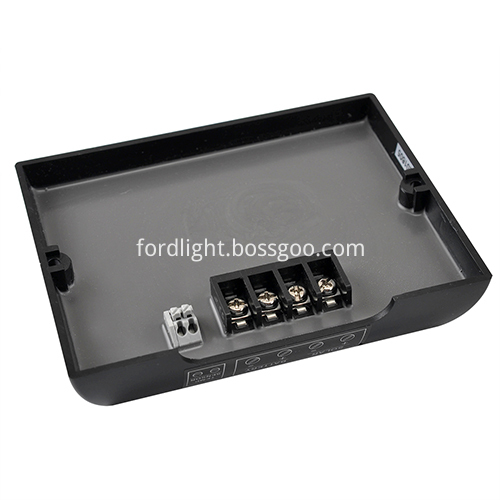
This diagram illustrates the connectivity of a typical solar power kit, including a solar panel, a Solar Charger, a battery and the load (e.g. a light bulb). The solar panel connects to the Solar Charger through positive and negative leads, only creating a charging function when the Solar Charger is connected to a battery. The load is then responsible for the discharging function from the Solar Charger (if it is connected to the Solar Charger).
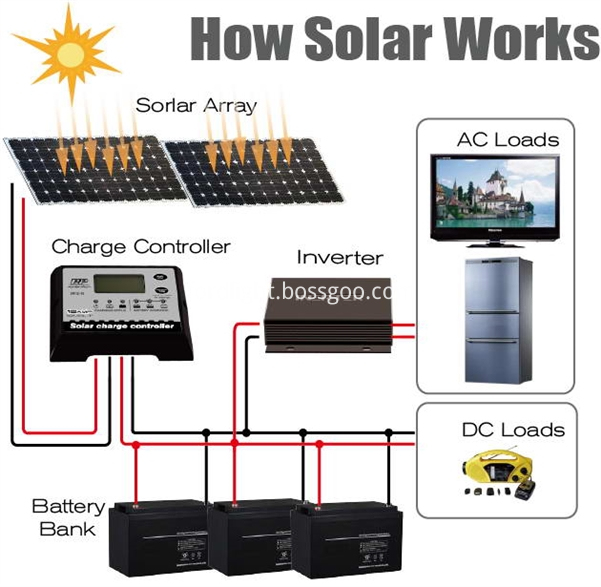
NB: In some rare cases, a solar panel can be connected directly to a battery, without a Solar Charger. This can be achieved if the nominal voltage of the panel is lower than 17-18V, and if the solar panel is a lot smaller than the charging battery e.g.. a 10W panel charging a 100Ah battery.
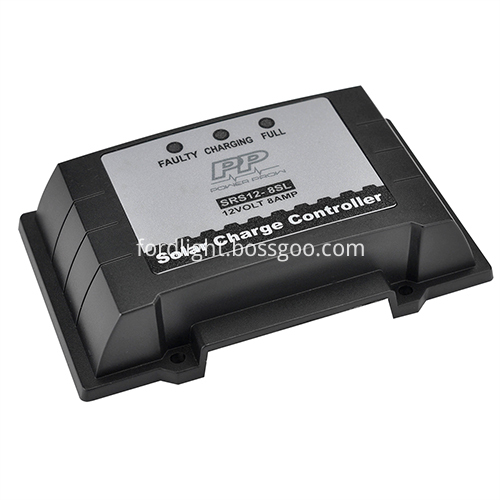
There are many different types of Solar Charger on the market. Choosing the right controller depends on the solar power system you would like to generate.
A brilliant little device that boasts compatibility, simplicity, and a utilitarian understanding of solar panels, batteries, and loads: it is included in most of our small and medium sized kits.
As it uses PWM technology, the amount of current and voltage that is lost between the panel and the battery is reduced to next to nothing. It can prolong battery life and also protect it from overcharging, undercharging, short circuiting, and overheating.
This Solar Charger does not have to be used solely on one panel and one battery; a 10A PWM Solar Charger cab be used to regulate the charge of an array of solar panels connected in parallel with a total power of 160W. If you were to get a 20A PWM Solar Charger, you would be able to regulate a solar panel bank of up to 320W for 12V batteries, and 640W for 24V batteries.The PWM Solar Charger can also be used to connect solar panels to a battery bank of 12V batteries, provided that the batteries are the same size and that they are in good condition. The 10A Solar Charger is also conveniently compact, at only 14 x 7 cm.
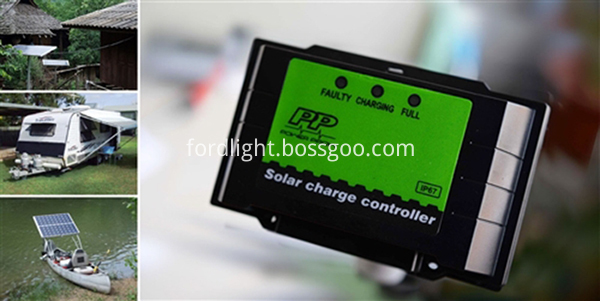
Controllers with LCD displays
The programmable features allow the user to customise the charging process by setting the battery type and the capacity, choosing charging voltages at each stage, setting protection parameters, and by switching the load on and off by timer.
These Solar Chargers put the power in the owner`s hands, and makes a solar circuit much more advanced and controllable. An LCD display gives you information about many things, including:
-the solar panel current/voltage, the battery current/voltage
-the state of charge of the battery
-the temperature
-current charging stage
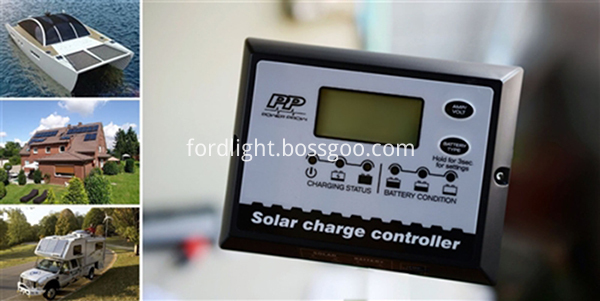
Dual Solar Chargers
This can be used to monitor and regulate two independent (electrically isolated) batteries at the same time.
It is an essential item for anyone looking to charge both their leisure battery and their engine battery, or anyone who wants to charge a bank of several 12V leisure batteries and a starter battery at the same time.
The user has two charging options: to charge both of the connected batteries at an equal rate, or to give one battery charging priority (e.g. 80% of power to go to the engine battery and 20% to the leisure battery). A remote display can be equipped to this Solar Charger so that the user has more control over the regulation between the two batteries. Despite being called a "dual Solar Charger", it can also be used to charge one battery - a second battery can be added later.
Waterproof Solar Chargers
These Solar Chargers are specifically designed for wet environments.
In terms of functionality, they are almost completely identical to the standard 10A PWM Solar Charger. It has multiple settings for timer-controlled load work, which is ideal for street lighting and perfect for anyone who wants to set up a solar charging kit on their boat.
MPPT Solar Chargers
Along with PWM, there is one other method of Solar Charger that is considered the most efficient method: MPPT (Maximum Power Point Tracking).
MPPT Solar Chargers are the most efficient and powerful Solar Chargers that we offer, but they should only be used when the solar panel voltage is much higher than the battery voltage. An MPPT system is able to lower the voltage of a panel (or an array of solar panels) that is up to ten times higher than the voltage of a battery to match the voltage of the battery without losing any of the current in the process. The MPPT Solar Charger works at a higher efficiency rate than the PWM Solar Charger; while a PWM Solar Charger operates at an efficiency level of 75%-80%, an MPPT Solar Charger operates at an efficiency rating of 92-95%.
MPPT Solar Chargers also boost the amount of current going to the battery, which can vary in amount depending on the weather, the temperature, the battery state of charge, and other factors. There would be no negative repercussions from using a MPPT Solar Charger on a solar panel with a voltage close to the battery voltage, but the benefits from MPPT in this sort of system would be much lower.
It has the same protective features as the PWM Solar Chargers. We include a 20A MPPT Solar Charger in our 200W/250W kits, due to the fact that an MPPT Solar Charger allows the panel to operate at the maximum level that it can. Some have built-in LCD displays, while others have RJ45 sockets for a remote meter that allow you to monitor the charging process.